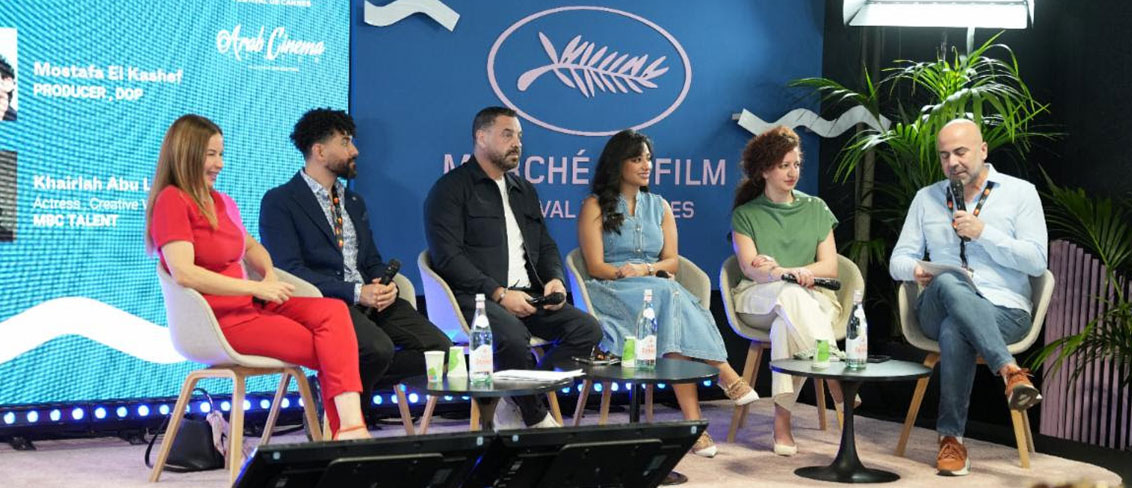
The Arab Cinema Center (ACC) hosted a vibrant panel titled “Rising Forces: Arab Talent Regionally and Internationally” at the Cannes’ Marché du Film, moderated by ACC Co‑Founder and MAD Solutions CEO Alaa Karkouti.
Taking place on May 16th on the Main Stage, the session brought together leading figures from across the Arab film landscape to explore the rapid transformation of regional cinema, the surge of Arab talent making waves internationally, and the challenges that remain in building sustainable structures for global success, from the rise of Saudi Arabia’s burgeoning ecosystem to the resilience of Arab composers and filmmakers competing on international platforms and much more.
During the panel, renowned presenter Raya Abirached, host of Scoop with Raya, emphasized how Arab talents — both in front of and behind the camera — are now making waves internationally in ways she never imagined possible several years ago. Citing names like Rami Malek, May Calamawy, and Kaouther Ben Hania, she noted, "It's very exciting to see that talent matters more than being of a certain nationality in Hollywood and a certain prototype, which are becoming less and less important in recent years, and we are seeing much more talent, whether of Arabic origin or even Arab talent, being represented in Hollywood.”
She further stressed the importance of supporting Arab cinema as a catalyst for sustained growth, saying, “The more we give it budgets, the more it's going to grow. We are seeing the rise of studios in the Arab world, talent agencies and structures that are getting better and better; if we continue on that path — if we continue giving cinema the kind of financial and emotional support it needs—it will grow very nicely.”
And on what makes a film commercial and successful with audiences, Director Tarek Alarian, founder of RAW Entertainment, said, “Whatever the genre is, if you make it very well and the topic is interesting from the beginning, with a good script that is credible and touches you emotionally, I believe it would do good in the box office,” he explained.
Reflecting on his own journey, he added, “We work harder since you almost work by yourself, doing a million things, and sometimes even your ideas aren’t accepted, even though you’re certain they’ll succeed. I’ve faced this many times, and maybe that’s why it takes me longer to make a film — developing the script and the idea, then moving into casting. But it is getting much better now. You push things forward, and if they work, you gain credibility to move on to the next project.”
Speaking candidly about the challenges and determination required for Arab talent to thrive internationally, composer Suad Bushnaq stated, “We are western-trained, but our names and our faces sometimes stand in the way, so you have to prove yourself more and more to convince them that I am not going to bring my Arabism to the work.”
“On the other hand, it also forces us to raise the level of our production — we are not going to put anything subpar out there because we are being played against bigger names in the industry. You have to make sure that you are going above and beyond, just to convince the producers or the directors that not only am I going to do it, but I am also going to do it the best I can and the best you will ever hear,” she added.
Meanwhile, composer Amine Bouhafa reflected on the challenges he faced in the industry at the beginning of his career. “More in the beginning of my career, it took time to change the vision of people, to tell them that I am able to do something else, that I can serve your movie. I am not just a musician with the fantasy of doing music.”
“After seeing my music and the films that went to the Oscars or the Netflix and HBO shows, they started looking at me not just as an Arab composer but simply as a composer. In this industry, everything is about trust, and trust takes time to build. A career takes time to build. You need to prove that the quality of the work you do is beyond and above what another composer of Western nationality can do.”
Also on the panel was actress and MBC talent Khairiah Abu Laban, who shared her personal journey from YouTube beginnings to Netflix productions amid the burgeoning scene in Saudi Arabia. “As an actress, I started acting in 2011 in a series that was released on YouTube. Now the same project is on Netflix, so I am feeling this change and transformation personally. I used to have YouTube clips; now I have films and series, and I can see my face on a panel in Cannes. That wouldn’t have been possible ten years ago,” she said.
When asked about the priorities of her ambitions, be they local, regional, or international, she said, “All we need is time, and I believe that to be international, you have to start locally. In Saudi Arabia, we are open to so many experiences around the globe. I always believed the Middle East is not just the Middle East — it is also an international market.”
About Marché du Film
The Marché du Film, the business hub of the Festival de Cannes, is the world’s largest international gathering of film professionals. As a key step in the development, production, and distribution of films globally, the market brings together over 12,500 professionals (including producers, distributors, festival representatives, film institutions, buyers, and financiers) from more than 120 countries to exchange ideas, projects, and strike deals in a unique environment.
Website:
www.marchedufilm.com
About Arab Cinema Center
Founded by MAD Solutions in 2015, the Arab Cinema Center (ACC) is a non-profit international platform promoting Arab cinema. Registered in Berlin, the ACC provides its partner companies with a tangible presence at all major film festivals and markets, organizes industry events, and publishes special editions of the Arab Cinema Magazine.
Website:
http://acc.film/