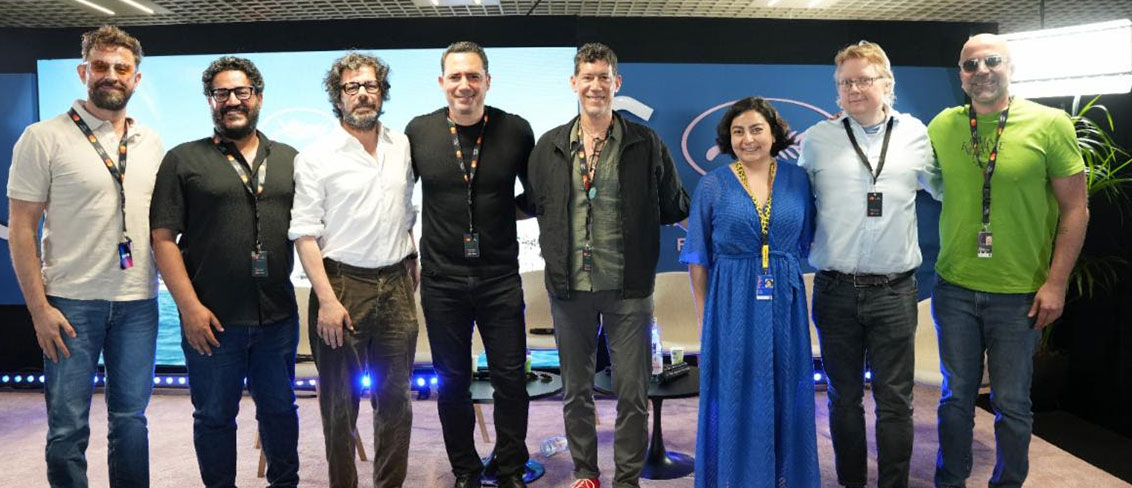
Arab Filmmakers Discuss Creative Freedom through Cross-Border Collaboration at Arab Cinema Center’s Cannes Panel
Hosted before a packed audience at the Marché du Film, the Arab Cinema Center presented a compelling panel titled ‘Scaling Stories: Co-Productions Driving Commercial Growth in the Region.’ The discussion underscored the vital role of co-productions as the primary engine of global film industry growth, with the Arab world increasingly cementing its place in that commercial equation.
The panel, moderated by Michael Rosser (Asia & Middle East Editor at Screen International), addressed a profound structural shift currently reshaping cinema. Projects are no longer being built within isolated, single territories; instead, they rely on cross-border partnerships that unlock fresh financing, expand audience reach, and maximize commercial viability. The core question is no longer whether co-productions are useful but how they are actively redefining the very boundaries of regional cinema.
Producer Myriam Sassine shared her firsthand experience: “I understood very quickly that co-production is not only financial, but it's also something that is a collaborative creation… So I decided to only work with the partners who argued back like it was a creative debate that would push the film further.”
Sassine advised filmmakers to diversify their production sources by exploring untapped markets in Latin America and Asia. She also lauded the rise of dynamic Arab entities, specifically highlighting MAD Solutions, for bridging critical gaps across the supply chain by integrating distribution, sales, private equity, and financing.
A testament to this evolving landscape is the Iraqi Film Fund, which received over 400 project submissions upon its launch. Wareth Kareem — filmmaker, producer, and Executive Director of the Fund — emphasized the vital necessity of intra-Arab collaboration. “As filmmakers, we need to help ourselves to get the attention of the people,” Kareem stated. “Thanks to organizations like the Arab Cinema Center and MAD Solutions, Iraqi cinema is being thrust into the spotlight. It shows we are no longer fighting for representation in the media; we are actively supporting one another to tell our stories.”
Shifting the focus to narrative integrity, actor, writer, producer, and director Dhafer L’Abidine prioritized creative alignment among partners over the sheer size of a budget. He argued that a co-production must strictly serve the creator's vision to birth authentic stories that resonate locally and endure long after their festival runs.
However, the speakers collectively acknowledged a persistent hurdle: maintaining narrative control. While foreign production entities often shy away from war narratives, Arab filmmakers carry a profound repository of conflict-related stories that demand to be told as a vehicle for collective healing.
In that sense, Kareem noted, “Iraqi and all Arab filmmakers are not only looking for funds but are also looking for open windows and more Arab co-productions. That's why we are making something with MAD Solutions to focus on that, to bring the Arab co-productions."
Offering a distinct economic lens, Marco Orsini, writer, director, producer, and Founder of the IEFTA, and Wissam Smayra, director, producer, and Founder of Clandestino Films, championed integrating private equity into the co-production model, viewing it as the industry's ultimate catalyst. Orsini firmly believes that this combination will grant future filmmakers creative freedom, “allowing filmmakers to choose who to work with and where to work. Hopefully, we can start working in the home regions with all of these projects to start really building a formidable industry locally, meaning the MENA region.”
The panel moderated by Michael Rosser (The Editor of Asia and Middle East for Screen International) featured Wissam Smayra, director, producer, and Founder of Clandestino Films; Marco Orsini, writer, director, producer, and Founder of the IEFTA; Myriam Sassine, producer; Dhafer L’Abidine, actor, writer, producer, and director; and Wareth Kareem, filmmaker, producer, and Executive Director of the Iraqi Film Fund.
About Marché du Film
The Marché du Film, the business hub of the Festival de Cannes, is the world’s largest international gathering of film professionals. As a key step in the development, production, and distribution of films globally, the market brings together over 12,500 professionals (including producers, distributors, festival representatives, film institutions, buyers, and financiers) from more than 120 countries to exchange ideas, projects, and strike deals in a unique environment. Website:
http://www.marchedufilm.com/
About Arab Cinema Center
Founded by MAD Solutions in 2015, the Arab Cinema Center (ACC) is a non-profit international platform promoting Arab cinema. Registered in Berlin, the ACC provides its partner companies with a tangible presence at all major film festivals and markets, organizes industry events, and publishes special editions of the Arab Cinema Magazine.
Website:
http://acc.film/