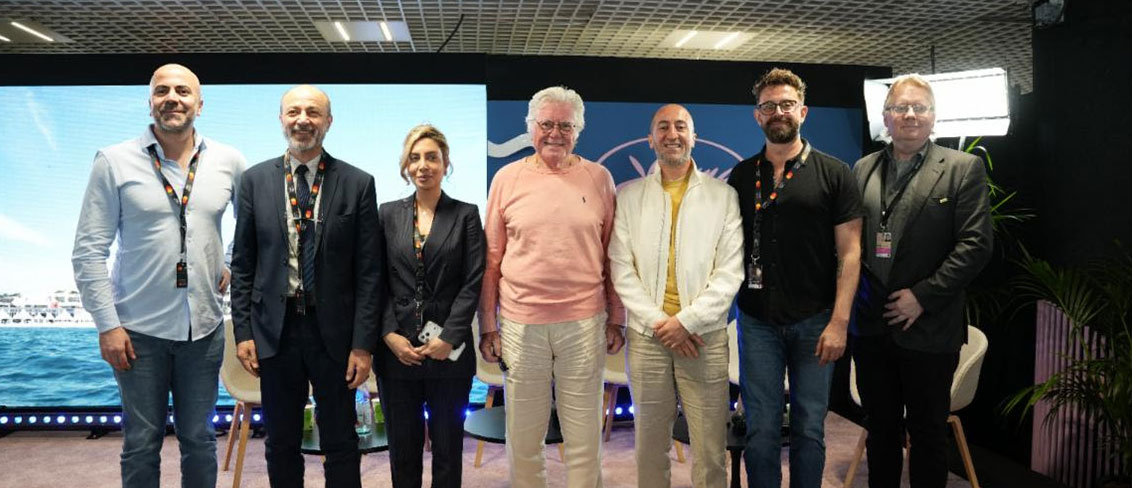
Arab Cinema Center highlights Arab Cinema’s response to regional changes at Cannes
The Arab Cinema Center, in collaboration with the Cannes Film Festival’s Marché du Film, hosted a panel under the title "Business Unusual: Growth and Innovation in a Changing Landscape,” on the Main Stage.
The panel, which was moderated by Michael Rosser, Asia and Middle East Editor at Screen International, focused on how entities and creators navigate complex challenges to unlock new opportunities. It showcased the resilience and adaptability of the region’s film and television industry to innovate despite the rapidly accelerating changes in the surrounding environment.
During the panel, veteran star Hussein Fahmi, President of the Cairo International Film Festival, emphasized the central role of the audience in the film industry’s growth, stating, "We are here for the audience. I have spent my entire career in this field, and the audience is inherently neutral — they are neither for you nor against you. What the audience wants is to be entertained; they came here for entertainment and enjoyment. The question here is, how do you create joy and entertainment for the viewer? Otherwise, you will lose them.”
“In Egypt, we went through difficult times due to the revolution and the COVID-19 pandemic, which kept people away from theaters and cinemas, as all venues were closed and movement stopped, until we had to return gradually. All of this naturally affected films and the industry itself, and it also impacted the passion and the spirit of going to the cinema."
Speaking about the challenges facing the film industry, Hussein Fahmi said, "Going to theaters is now again confronted by the rise of new technology; we have all these facilities and platforms, and anyone can watch a movie on their mobile phone. So, things have changed tremendously now. We no longer really know who our audience is, because more cinemas are closing their doors, not only in Egypt but also all over the world.”
“These changes have altered the public mood because we must understand that this viewer is part of the public, which is heavily influenced daily by economic and political conditions. You can produce a film, and by the time it is released six or seven months later, things in society may have already changed; you might adopt a certain idea or a specific political opinion, and then after six months, the data changes and the audience changes due to social shifts that may contribute to the success of the work or vice versa."
On how the audience is affected by circumstances and shifts in the general mood, Alaa Karkouti, co-founder of the Arab Cinema Center and CEO of MAD Solutions, pointed out that the situations the region went through had a major impact on cinema, referencing the COVID-19 pandemic and the Iranian-American tensions. He explained that the decision for an early closure for a whole month in Egypt led to the loss of late-night cinema screenings. Although the government lifted the decision and restored normal working hours, that month became an intensive case study on how the audience's mood changes and how their access to entertainment can be suddenly altered.
Building on Hussein Fahmi’s earlier point about the public mood, Alaa Karkouti stressed that this example illustrates how the psychological state of the audience shapes content consumption, especially during critical seasons like Ramadan. "When real-world factors (such as economic and political changes or imposed schedule restrictions) weigh heavily on the collective consciousness, many people's first reaction is to seek immediate relief. This is precisely what drives the audience to choose a comedy film or series as their first choice during Ramadan. The viewer's mood is highly volatile; a producer may develop an idea, but by the time the film is released six or seven months later, the social climate has completely changed, reshaping how that message is received," Karkouti said.
He also cited GOODBYE JULIA, the first Sudanese film to screen at the Cannes Film Festival, explaining that the film preceded the outbreak of the war in Sudan but gained massive attention after the war occurred because it captured a deep and universal human truth at the exact right moment.
Regarding how Arab film entities deal confidently with international partners in a region perceived by some as unstable, Zaid Shaker, Acting Executive Director of Film AlUla, explained that it is a matter of resilience, flexible building, and strategic planning, saying, "AlUla started with a very strong and distinctive proposition centered on diverse and beautiful filming locations; however, having beautiful places was not the sole purpose. At its core, it was about building and scaling ourselves and our industry. Today, we have active and constantly growing partnerships to activate the role of the private sector, which began with promoting AlUla.
“Looking at our reality today, we provide support to filmmakers through partnerships and invest in capacity-building and talent development pathways. It started by gradually and carefully promoting the studios through the partnerships we established with Manhattan Beach Studios. This represents one aspect of our ongoing work to enhance and improve our filming operations and to develop procedures and mechanisms that ensure full transparency for any entity wishing to come and shoot here,” he continued.
“The significant growth achieved by AlUla to emerge as a globally trusted production partner is the result of a deliberate and planned process of growth and expansion, which forms an essential part of our resilience, adaptability, and recovery. If some, out of ignorance, link unrest in one country in the region to other countries in the region, we cannot do other people's work; the role of each party and part of their responsibility is to seek learning and to come by themselves to see and explore," he added.
Bavi Yassin, Founder and Chairperson of the Kurdistan Film Commission, said, "There is something very important that I do not like to sugarcoat because we sometimes find ourselves, when we defend what is important about our region, obligated to not only show that our region is stable but also ready for film production. For that very reason, I did everything in my power so that we could come here and launch our first initiative, which is the first Kurdish Film Fund dedicated to supporting Kurdish narratives and Kurdish filmmakers this year. Because I am absolutely tired of the stereotype that always portrays us as victims in the global media.”
“I am tired of the labeling and the international media classifying us with phrases like 'the entire Middle East is unsafe just because events occur in one country!' They look at us as a collective, packed together. It is like assuming that if something happened in a European city, people are suddenly not allowed to go to London! Is that how things are run in Europe? I don't think so, but that is the stereotypical way some people look at the Middle East," she continued.
"Therefore, we are here today, each representing their own identity and part of the picture, but at the core and depth, we are all friends, and we support each other; if any party among us achieves an accomplishment or success, I will be the first to celebrate and cheer for them, because their success represents us all. What I absolutely loved about your talk regarding the content strategy is that the strategy I am currently working on does not start directly with the immediate construction of studios and backlots. If I need that, I will simply go to AlUla to shoot there! This is how things are run, and this is how real cooperation and integration should be in the Middle East and North Africa (MENA) region. But the core of my project and the primary goal I want to achieve is to change the stereotype shaped by the history of wars we have been through," she added.
Discussing the the future of Syrian cinema after years of war, actor and filmmaker Jihad Jay Abdo, CEO of the National Film Organization in Damascus, Syria, explained that he initially hesitated to accept the position, clarifying, "The National Film Organization started out great, producing great and very good films with Syrian directors, actors and all elements of this entertainment industry, and we did indeed present high-level cinematic works. But ultimately, it was steered down a path that I did not like at all, as it turned into a tool to praise the government and the army."
"We inherited a country suffering from a massive financial deficit and a kind of moral deficit as well. Now, we have a new team trying to rebuild this organization and reunite the entire entertainment and film industry. At the end of the day, we were divided and split, and we have different views and visions, but what unites us now is the message that we want to deliver — not only locally but also from Canada to the smallest village in China. We need to show the world who Syrians really are.”
And speaking on the steps taken to reform the industry in Syria, Jay Abdo said, "We are trying to restructure this system and make it reasonable, humane, and artistic because we are working in a highly creative business, as you know. Changing such laws and regulations through parliament requires amending old laws, which is a process that naturally takes time. So, this is our first priority.”
“Furthermore, we need to change this reality so that corruption is no longer a necessity and so that no one feels pursued or threatened. My message to everyone is, 'Please, come and join me; even if I do not agree with your opinion, let us work together to create and produce something because we can and we have the talent.' These are the two main challenges we face, in addition to the financial deficit."
The panel brought together a distinguished group of prominent filmmakers and industry officials in the region, including veteran actor Hussein Fahmi, President of the Cairo International Film Festival; Bavi Yassin, Founder and Chairperson of the Kurdistan Film Commission; Zaid Shaker, Acting Executive Director of Film AlUla; Alaa Karkouti, Co-Founder of the Arab Cinema Center and CEO of MAD Solutions; and actor and filmmaker Jihad Jay Abdo, General Director of the National Film Organization in Damascus, Syria.
About Marché du Film
The Marché du Film, the business hub of the Festival de Cannes, is the world’s largest international gathering of film professionals. As a key step in the development, production, and distribution of films globally, the market brings together over 12,500 professionals (including producers, distributors, festival representatives, film institutions, buyers, and financiers) from more than 120 countries to exchange ideas, projects, and strike deals in a unique environment.
Website:
www.marchedufilm.com
About Arab Cinema Center
Founded by MAD Solutions in 2015, the Arab Cinema Center (ACC) is a non-profit international platform promoting Arab cinema. Registered in Berlin, the ACC provides its partner companies with a tangible presence at all major film festivals and markets, organizes industry events, and publishes special editions of the Arab Cinema Magazine.
Website:
http://acc.film/